

The Northwest Arkansas Women’s Shelter (NWAWS) advocates for survivors of domestic violence every month of the year. But during October 2026, which is Domestic Violence Awareness Month, we doubled down on our focus of educating our community on the impact of domestic violence (DV), how to recognize it, help others, and/or get help yourself.
Defining Domestic Violence
Domestic violence starts long before someone lays hands on you, and it rarely happens in a vacuum. Survivors of physical DV note the emotional, psychological, and mental abuse that precedes the physical in nearly all cases.
Domestic violence or abuse is defined in Arkansas as:
“…physical harm, bodily injury, assault, or the infliction of fear of imminent physical harm, bodily injury, or assault between family or household members; or any sexual conduct between family or household members, whether minors or adults, which constitutes a crime under the laws of the State of Arkansas.”
It is important to note that abuse can occur outside of the family unit as well. Romantic partners who are not cohabitants, as well as non-romantic partners, roommates, or friends can also be abusive.
So how can we recognize abuse for what it is?
What Does Abuse Look Like?
Because abuse does not always involve physical violence, survivors are led to believe that certain behaviors are normal, when they are not. This is one of many reasons why survivors may stay in an abusive situation.
Types of Abuse
Emotional Abuse
Definition: Any non-physical behavior or actions that are meant to control, manipulate, intimidate, and/or hurt another person.
This can look like:
- Putting you down verbally, making you feel insignificant.
- Gaslighting, causing you to question your own intuition, feelings, or even reality.
- Making negative comments about what you should or shouldn’t do under the guise of “helping.”
- Threatening to harm you, themselves, or others if you don’t do what they want.
- Taking no ownership or accountability for their actions or moods.
- Ignoring boundaries and claiming that their love is an excuse for violating boundaries.
- Unrealistic expectations.
- Love bombing: Suddenly being attentive and affectionate, often with gifts, after a disagreement or outburst.
- Weaponized incompetence, such as refusing to help with housework because they’re “not good at it.”
- Defined gender roles: Men do this/men don’t do this; women do this/women don’t do this.
- Forcing shared accounts and passwords; eliminating the need for privacy.
Financial Abuse
Definition: Control through limiting, or eliminating, your access to financial security.
This can look like:
- Moving accounts under the abuser’s name without consent.
- Changing passwords and/or security questions on joint accounts to make access more difficult.
- Strict monitoring of the survivor’s spending and/or enforcing an allowance.
- Withdrawing money from your or your children’s accounts without permission.
- Depositing money into inaccessible accounts.
- Preventing you from working, or coercing you to limit your work or quit your job. This gives the abuser financial control as the only one with an income.
Sexual Abuse
Definition: Forced or coerced sexual or physical intimacy, or using physical and sexual intimacy as a tool to control or manipulate.
This can look like:
- Forcing sexual or physical intimacy without consent.
- Performing sexual acts without consent.
- Coercing sexual activity when you are sick or tired.
- Purposely hurting you during sex.
- Including others in sexual activity against your will.
- Generally ignoring your feelings regarding sex.
- Forcing you to do anything sexual that you are uncomfortable with or do not wish to do.
Power and Control
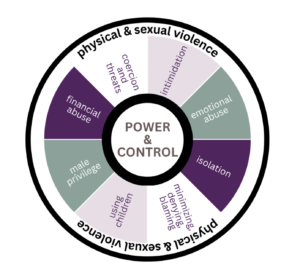
There is a tool called the Power and Control Wheel that lays out the tactics that abusers use to control their victims.
The outer ring of the wheel is where an abuser uses physical and/or sexual violence, but the spokes of the wheel are all the non-physical tactics that abusers use with or without physical violence. All of these elements lead to the abuser holding all the power and control.
How to Get Out Safely
If you or someone you love is in an abusive relationship, it is important to maintain safety when getting out. Even if the abuse is not physical that does not mean it might not turn violent at any point. And the point at which a survivor tries to leave can be very vulnerable and dangerous.
Here are some steps for how to be safe while escaping an abusive situation:
- Tell someone you trust about your situation.
- Call a hotline (such as the national hotline).
- Call your local domestic violence shelter.
- Have a trusted friend help you get to somewhere safe, like to a shelter or friend or family member’s home.
- Call the police if there is violence or the threat of violence to yourself or your children.
- Make copies of important documents and keep them somewhere safe or with a safe person.
- Ensure digital safety once you have left by turning off location sharing and disabling similar features on any apps that you use.
- When it is safe to do so, browse the National DV Hotline’s interactive safety planning tool to make your own customized safety plan for yourselves, your children, and pets.
How to Support Survivors
Watching someone you care about experience abuse can be very difficult. It is hard for us to watch the people we love suffer, especially in a relationship that should be making them feel loved and supported. When offering your help it is important that, above all, you aim to empower the survivor to make their own decisions and provide love and support no matter what.
- Talk with them about their relationship somewhere private, where no one else can hear.
- Express your concern without blaming them or making them feel shame.
- Listen without judgement, and believe them.
- Do not pressure them to make immediate choices. Offer to help them learn about options, if they are interested. Offer to put together a list of resources.
- Respect their confidentiality. Assure them anything they share will stay confidential. (exceptions for mandated reporters).
- Respect their decision. Even if you disagree. Victims of abuse often have very little control in their lives. Respecting their choices is empowering.
- Ask them how you can help keep them safe, or support them; or support them in practical ways, such as offering to assist with cleaning/organizing, communicating with work, etc. Small things that will help ease their mental load.
- Offer to help make a safety plan.
- Be patient. On average, it takes a survivor 7 attempts to leave an abusive situation. Being patient and non-judgmental is crucial, and helps the survivor know that you are there for them when they are ready to leave.
How NOT to help a friend:
- Don’t try to save or rescue them.
- Don’t make judgements.
- Don’t give ultimatums.
- Don’t pressure them into leaving before they are ready.
- Don’t feel like you have to have all the answers or solve all the problems.
- Don’t ignore the situation.
How You Can Help
During Domestic Violence Awareness Month 2026 NWAWS focused on community education. But we cannot do this alone. Here are some ways you can help NWAWS in its mission to end domestic violence and build a safer community for everyone:
Donate
You can support NWAWS financially by donating here.
You can also support NWAWS through donating your old and gently used clothing and household items to the NWAWS thrift store. All proceeds benefit the shelter and survivors in our programs can shop there for free! (You can support the cause by shopping at the thrift store, too!)
Volunteer
If you are interested in volunteering with NWAWS, reach out to Rachael Schmidt, our Community Education & Engagement Director, at rschmidt@nwaws.org.
Raise Awareness
- Follow NWAWS on social media (Instagram, LinkedIn, Facebook) and share posts across your network
- Organize fundraisers in your neighborhood or community. This can be as simple as a garage sale or a barbecue.
Give your resources and time. Start the conversation. Together we can make a safer community for everyone.